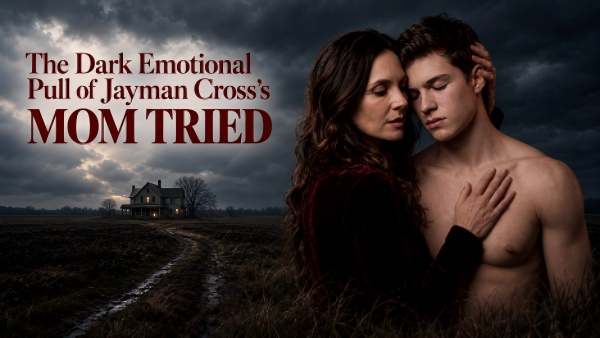
SAN FRANCISCO, CA, September 22, 2026 /24-7PressRelease/ — MOM TRIED is a work of adult fiction by Jayman Cross, intended for readers aged 18 and older.
Some houses feel bigger the emptier they get. In Jayman Cross’s MOM TRIED, a small farmhouse sitting far outside a quiet country town becomes exactly that kind of space, a place where every hallway seems to echo a little louder once the people who used to fill it are gone.
At the center of the story are a mother and her eighteen-year-old son, left to manage the farm and their lives together after the husband and father who once held the household together walks away. What follows isn’t a simple story about heartbreak or hard work. It’s a slow, uncomfortable look at what happens when two people who are supposed to occupy very clear roles, parent and child are left with almost nothing else to hold on to.
That’s the question MOM TRIED keeps circling back to: when loneliness becomes the only constant in someone’s life, what happens to the roles they’ve always known? This article takes a closer look at that question, and at how Cross uses isolation, emotional need, and quiet psychological pressure to build a story that many readers will find as unsettling as it is hard to put down.
A Farmhouse With Nowhere Else to Go
Setting does a lot of quiet work in fiction, and MOM TRIED leans on that heavily. The farm isn’t just a backdrop, it’s a kind of pressure chamber. There’s no steady stream of neighbors, no built-in reason to leave for the day, no easy distance between one family member and another. When something happens on the farm, whether it’s practical or emotional, there’s nowhere to send it but back into the house.
This is one of the reasons rural settings show up so often in dark, psychological fiction. Distance from other people removes some of the natural checks that usually keep relationships in balance: a friend’s opinion, a coworker’s schedule, a neighbor dropping by unannounced. Take those checks away, and what’s left is just the two people in the house, working things out entirely between themselves.
For the mother and son in MOM TRIED, that isolation isn’t dramatic or sudden. It’s the ordinary, grinding kind, the isolation of chores that need doing every day, of a farm that doesn’t run itself, of a town too far away to visit casually. Over time, it becomes its own kind of pressure system, quietly shaping how the two of them relate to each other. It’s part of why the book fits so naturally into the world of rural psychological fiction and dark farmhouse fiction genres where the setting isn’t just where the story happens, but part of why it happens at all.
When One Relationship Has to Carry Everything
Most people spread their emotional needs across a handful of relationships without ever thinking about it. A friend to laugh with. A coworker to complain to. A parent to lean on. A partner to come home to. When one of those pieces disappears, the others usually absorb some of the slack not painlessly, but manageably.
In MOM TRIED, that safety net barely exists. After the father leaves, the mother and son aren’t just short one family member they’re short almost every other connection that would normally help carry the emotional weight of daily life. What’s left is each other.
This is where the book’s exploration of emotional dependency becomes its most quietly devastating. The son, only recently an adult, becomes someone his mother increasingly leans on not just for farm work, but for company, for reassurance, for the simple experience of not being alone in the house. The mother, in turn, becomes the one steady presence in her son’s world at an age when most young people are just beginning to build a life outside their family.
Neither of them set out for this. It happens the way these things tend to happen in real life and in good fiction alike gradually, through hundreds of small moments where there was simply no one else to turn to. This is precisely why emotional dependency in fiction remains such a compelling subject for writers and readers alike. It doesn’t require a villain or a single bad decision. It only requires circumstances that leave two people with nowhere else to put their needs and MOM TRIED builds those circumstances with patience and care.
How Loneliness Starts to Blur the Lines
This is the heart of what makes MOM TRIED such an uneasy read, and it’s also the idea behind this article’s title. Family roles aren’t just labels they come with a whole set of unspoken rules about distance, dependency, and what kind of support is appropriate to ask for and to give. Under normal circumstances, those rules hold because life gives people other places to put their needs. Strip enough of that away, and the rules start to bend.
Cross doesn’t rush this part of the story, and that restraint is part of what makes it effective. The shift from “mother and son managing a hard situation together” to something far more complicated doesn’t happen in a single dramatic scene. It happens through accumulation through the son becoming more of a partner in decision-making than a child following instructions, through the mother beginning to rely on her son the way she might once have relied on her husband, through both of them slowly losing the outside perspective that would normally remind them where the boundaries are supposed to sit.
Without anyone else around to notice or gently correct course, the roles that once felt fixed start to feel more like suggestions. This is a theme fiction has returned to again and again: how isolation affects human relationships, and how easily roles can blur when the usual structures holding them in place quietly disappear. MOM TRIED doesn’t offer easy answers about where exactly that line gets crossed. Instead, it asks readers to sit with the discomfort of watching it happen in slow motion.
The Space Between Care and Something Else
As the story develops, MOM TRIED moves into genuinely difficult territory, a forbidden attraction that grows between two adults who share a family bond neither of them chose to complicate.
This is the part of the book that will be the hardest for many readers to sit with, and it’s also the part this article treats with the most care.
Cross doesn’t present this development as something uncomplicated or easy for his characters. Both the mother and the son experience real internal conflict, a tangle of guilt, shame, secrecy, and confusion that runs through the second half of the story. Neither character is written as simply “giving in” to desire without cost. The narrative consistently makes clear how much distress this situation causes both of them, even as it continues to develop.
That internal conflict is really the engine of the book. MOM TRIED isn’t interested in the forbidden relationship as a spectacle, it’s interested in what it costs the people living through it. Every step toward each other comes with an equal or greater step into secrecy, self-doubt, and fear of what they’ve become.
It’s worth being direct about something here: MOM TRIED does not present this relationship as healthy, safe, or something to be admired. It’s written as a dark and difficult consequence of extreme isolation and emotional need, a portrait of how far two people can drift from the boundaries they once respected when nothing is left to hold them back. The secrecy and shame in literature that surrounds moments like these isn’t incidental to the story. It’s arguably the entire point.
Why Fiction Goes to Places Like This
It’s a fair question to ask: why would anyone want to read about this? Dark, taboo, and morally complicated fiction has always had an audience, and there are real reasons for that beyond simple curiosity. Fiction gives readers a way to sit with human behavior they’d never want to encounter in real life, from a safe enough distance to actually think about it. A well-written taboo story doesn’t ask readers to approve of what’s happening, it asks them to understand how it could happen at all.
MOM TRIED fits into that longer tradition of provocative fiction for mature readers stories that use discomfort on purpose, not for shock value, but to get at something true about isolation, need, and the fragile nature of the boundaries people count on. Readers drawn to forbidden relationship novels and controversial adult fiction are often looking for exactly this: a story willing to go somewhere most books won’t, and honest enough to show the real weight of getting there.
What Cross seems most interested in is the psychology: the loneliness that builds long before anything forbidden happens, the emotional dependency that quietly replaces a family’s usual structure, and the guilt and secrecy that follow once the line has been crossed. Readers who come to MOM TRIED expecting a “healthy” or “happy” version of a forbidden relationship will find something very different: a story that treats its characters’ choices as genuinely costly and morally fraught.
Who This Book Is Written For
MOM TRIED isn’t a book for every reader, and it isn’t trying to be. It’s written specifically for adults aged eighteen and older who are drawn to fiction that doesn’t look away from difficult subjects.
Readers who tend to enjoy dark adult fiction and adult fiction will likely recognize the shape of this story quickly. The same goes for anyone who gravitates toward psychological fiction for adults or morally complex adult fiction, where characters aren’t easy to categorize as good or bad, only human and flawed under pressure. MOM TRIED will also likely appeal to readers interested in forbidden relationships in literature and stories about crossed boundaries, as well as fans of complex family relationship novels and rural, isolated settings with a quiet, dread-laced atmosphere.
This isn’t a book for readers looking for something light, comfortable, or easily resolved. It’s for readers who want fiction that explores uncomfortable subjects honestly, without pretending those subjects are simple.
A Story That Leaves Readers With Questions
By the time MOM TRIED reaches its most difficult chapters, it has stopped being a story about a mother and son managing a farm alone. It’s become a story about what isolation can do to people who never asked to be tested this way about how quickly the roles we take for granted can bend under enough loneliness, and how much guilt and secrecy can grow in the space that’s left behind.
Jayman Cross doesn’t offer readers a tidy resolution to any of it, and that feels intentional. MOM TRIED isn’t trying to tell readers how to feel about its characters. It’s asking them to sit with the discomfort of watching two people lose their footing, one small moment at a time, and to think honestly about how much of what happened came from circumstance rather than choice.
That’s ultimately what makes the book worth discussing, even for readers who find its subject matter genuinely hard to sit with. MOM TRIED isn’t asking to be liked. It’s asking to be understood as a dark, psychologically intense look at what loneliness can do to the people it touches.
Explore MOM TRIED by Jayman Cross
MOM TRIED is available now through Amazon KDP for adult readers aged 18 and older. If this look at isolation, emotional dependency, and forbidden desire in fiction resonated with you, MOM TRIED is worth exploring for yourself with the understanding that it is a dark, mature story meant to be read thoughtfully.
Readers can follow Jayman Cross across the following platforms:
● Follow him on Instagram
● Follow him on Facebook
—
For the original version of this press release, please visit 24-7PressRelease.com here
Legal Disclaimer: The content on this page is syndicated from independent third-party providers. Kyrion Media makes no warranties or representations regarding the accuracy, completeness, legality, or reliability of the information, including text, images, videos, or licenses. If you are affiliated with this content or have any complaints, copyright concerns, or requests for removal, please contact us at [email protected] with the specific URL of the content in question. We will review and address valid requests promptly.