Busan, South Korea, November 14, 2026 – Indian-Canadian Web3 developer Riyan Patel has officially launched a blockchain-based OMS (Open Money Stack) service in August 2026, entering the decentralized finance infrastructure market. Patel has built up experience in on-chain data analysis and blockchain transaction design within the Web3 industry, and is known to have worked on several on-chain data projects with his older brother, Adit Patel. Through that work, he said, he came to believe that transaction transparency, data traceability, and trust between users could become the foundation of future financial services.
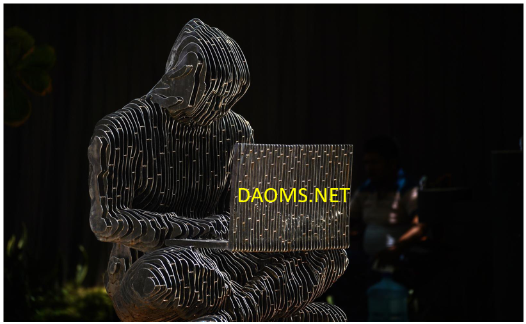
DAOMS.NET (hereafter DAOMS), which he has now launched independently, is a system that integrates ordering, trading, settlement, and management functions within a blockchain transaction environment. The company highlights the application of escrow to a blockchain OMS, describing it as a “world-first-caliber attempt.” It also provides a decentralized wallet, OMWIX, for user convenience.
Escrow is a mechanism in which payment is held securely by a neutral third party until agreed conditions are met. It is already a familiar concept in traditional finance and e-commerce, and combining it with a blockchain OMS could help reduce trust issues in P2P trading, OTC trading, digital asset exchange, and global payments.
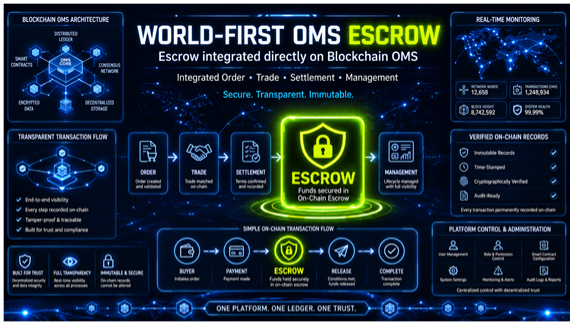
Patel emphasized that his goal with DAOMS is to make decentralized finance, which has often felt complex and difficult, more accessible to everyday consumers. Where existing Web3 services have largely been designed around developers, investors, and high-risk asset traders, DAOMS focuses on a trading environment that general users can also approach. The key, he said, is not simply providing trading functions but building trust into the system itself. By combining blockchain transparency, the traceability of on-chain data, and escrow safeguards, the service aims to let users trade with a certain level of protection even when they do not know their counterparty well.
This structure could be applied across a wide range of areas, including cross-border remittances, P2P asset trading, digital goods payments, freelancer payouts, community-based economies, game item trading, and tokenized asset markets. Industry observers say such developments could offer a technological alternative to problems facing finance today: access, consumer protection, trust in transactions, data sovereignty, digital asset management, payment costs, and financial exclusion. Some also expect the infrastructure to work as a new financial network in regions with limited access to bank accounts and in markets where cross-border transaction costs are high.
Concerns remain, however. As blockchain financial services expand to general consumers, issues such as regulation, security, privacy, anti-money laundering, fraud prevention, and excessive speculative trading are bound to grow as well. Nor does escrow eliminate every risk. Smart contract errors, the scope of the operator’s responsibility, standards for resolving disputes, conflicts with national regulations, and user authentication remain unresolved challenges. There is also a risk that consumers who do not fully understand how blockchain transactions work may place faith in the technology that turns into a false sense of security.
In this respect, DAOMS is drawing attention as an experiment showing how decentralized finance can complement, rather than simply replace, traditional finance by addressing the trust costs and access problems it has failed to solve. As blockchain, AI, on-chain data, escrow, digital identity verification, and regulatory technology converge, financial services are expected to evolve in a faster and more open direction.
For that change to be sustainable, however, technological innovation alone is not enough. User protection, transparent operations, responsible platform design, cooperation with regulators, and a service experience that consumers can easily understand must come together. Ultimately, the future of blockchain finance depends not on faster transactions but on more trustworthy ones, and the launch of DAOMS can be seen as an attempt to redesign that structure of trust.
For more information, visit https://daoms.net.
Legal Disclaimer: The content on this page is syndicated from independent third-party providers. Kyrion Media makes no warranties or representations regarding the accuracy, completeness, legality, or reliability of the information, including text, images, videos, or licenses. If you are affiliated with this content or have any complaints, copyright concerns, or requests for removal, please contact us at [email protected] with the specific URL of the content in question. We will review and address valid requests promptly.