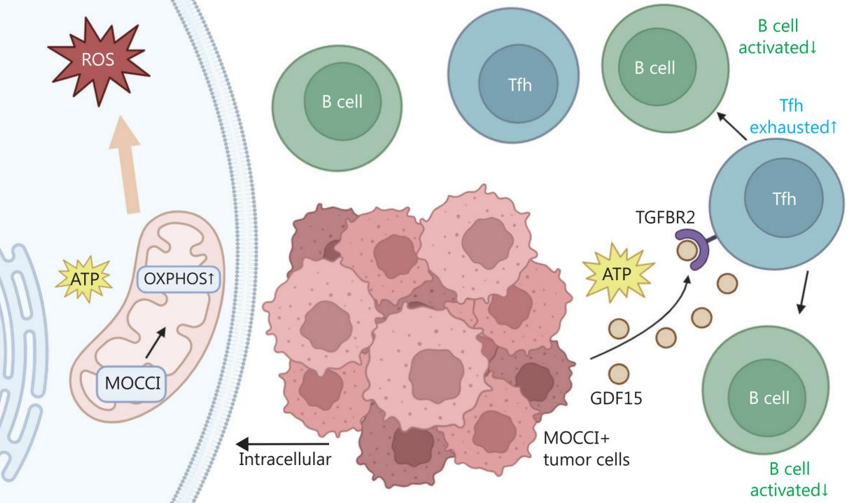
KNOXVILLE, TN, November 17, 2026 /24-7PressRelease/ — Lymph node metastasis is associated with poor prognosis in lung cancer, but the role of tumor metabolism in this process remains unclear. This study identifies a primary lymph node metastatic cancer cell (PLMC) subgroup characterized by MOCCI-driven oxidative phosphorylation (OXPHOS) reprogramming. MOCCI enhanced mitochondrial respiration in lung cancer cells and promoted lymph node metastasis in mice. Spatial analyses linked MOCCI-positive PLMCs, through GDF15–TGFBR2 signaling, to follicular helper T (Tfh) cell exhaustion and suppression of adjacent B-cell activation. The findings link metabolic adaptation to immune remodeling during dissemination and suggest a potential target for intercepting lymph node metastasis.
Metabolic reprogramming plays a critical role in shaping the adaptive capabilities of malignant cells during dissemination. Metastatic lymph nodes have an immunosuppressive microenvironment, but the characteristics and underlying mechanisms of immune-cell dysfunction remain poorly characterized. MOCCI, short for Modulator of Cytochrome C Oxidase during Inflammation, functions as a component of mitochondrial complex IV under inflammatory conditions. The absence of spatial context in single-cell RNA sequencing has also limited the analysis of cell–cell interactions, particularly within lymph nodes. Previous single-cell studies have inferred metabolic reprogramming without clarifying how metabolically rewired tumor cells engage specific immune cells within lymph nodes in a localized manner.
Researchers at Fudan University Shanghai Cancer Center, with collaborators at the Shanghai Institute of Materia Medica, Chinese Academy of Sciences, published (DOI: 10.20892/j.issn.2095-3941.2025.0587)the study in Cancer Biology & Medicine. The team, led by corresponding authors Haiquan Chen, Yang Zhang, and Xiaoming Zhang, analyzed matched primary tumors, metastatic and uninvolved lymph nodes, and peripheral blood from 10 patients with lung cancer. They profiled 37 samples by single-cell RNA sequencing and 27 tissue samples by spatial transcriptomics, capturing 671,467 cells across the two datasets. They also used T-cell and B-cell receptor sequencing, functional assays, mouse models and an independent clinical cohort.
PLMCs showed significant enrichment of the OXPHOS pathway, and MOCCI expression correlated with OXPHOS activity. MOCCI knockdown in PC9 and A549 lung cancer cells reduced migration and invasion by more than 50% compared with controls. MOCCI overexpression increased mitochondrial respiration and reactive oxygen species generation, and promoted lymph node metastasis in mice. MOCCI-overexpressing PC9 and A549 cells secreted more growth differentiation factor 15 (GDF15); OXPHOS inhibition reduced GDF15 secretion. Tfh cells were more abundant in metastatic lymph nodes than in primary tumors and exhibited dysfunctional antigen-presentation programs. Naive and memory B cells were also enriched, with greater clonal diversity but blunted clonal expansion. Spatial analyses showed that Tfh cells expressing transforming growth factor beta receptor 2 (TGFBR2) within 40 micrometers of GDF15-positive PLMCs had increased inhibitory signatures and reduced MHC-II signatures compared with those near GDF15-negative PLMCs. In an independent cohort of 875 lung cancer cases, MOCCI expression was higher in patients with lymph node metastasis and correlated with higher nodal status. In lung adenocarcinoma cohorts, higher MOCCI expression was associated with poorer overall survival.
The authors regard MOCCI as a key driver of PLMC fate. In their proposed model, MOCCI-mediated OXPHOS reprogramming enhances GDF15 secretion, which acts through TGFBR2 to promote Tfh cell exhaustion and suppress activation of neighboring B cells. They conclude that these findings link metabolic adaptation to immune remodeling during lung cancer dissemination.
The study points to MOCCI-driven OXPHOS reprogramming as a potential target for intercepting lymph node metastasis. The integrated single-cell and spatial multi-omics atlas provides a resource for further exploration of the cellular states and spatial interactions underlying lymph node metastasis. The authors note that the multi-omics cohort included only 10 patients and that spatial heterogeneity among samples limited the identification of shared characteristics. They call for validation in larger cohorts and further experimental studies of the mechanisms underlying metastasis establishment and microenvironment remodeling.
References
DOI
10.20892/j.issn.2095-3941.2025.0587
Original Source URL
https://doi.org/10.20892/j.issn.2095-3941.2025.0587
Funding Information
The study was supported by the National Key R&D Program of China (Grant No. 2022YFA1103900), National Natural Science Foundation of China (Grant Nos. 82373309, 82430099, and 825B1005), Clinical Research Special Project of Shanghai Municipal Health Commission (Grant No. 202440070), Medical Research Special Project for Shanghai Science and Technology Innovation Action Plan (Grant No. 24Y12800400), and Strategic Priority Research Program of the Chinese Academy of Sciences (Grant No. XDB0940102).
About Journal
Cancer Biology & Medicine (CBM)
Chuanlink Innovations, where revolutionary ideas meet their true potential. Our name, rooted in the essence of transmission and connection, reflects our commitment to fostering innovation and facilitating the journey of ideas from inception to realization.
Related Link:
http://chuanlink-innovations.com
—
For the original version of this press release, please visit 24-7PressRelease.com here
Legal Disclaimer: The content on this page is syndicated from independent third-party providers. Kyrion Media makes no warranties or representations regarding the accuracy, completeness, legality, or reliability of the information, including text, images, videos, or licenses. If you are affiliated with this content or have any complaints, copyright concerns, or requests for removal, please contact us at [email protected] with the specific URL of the content in question. We will review and address valid requests promptly.