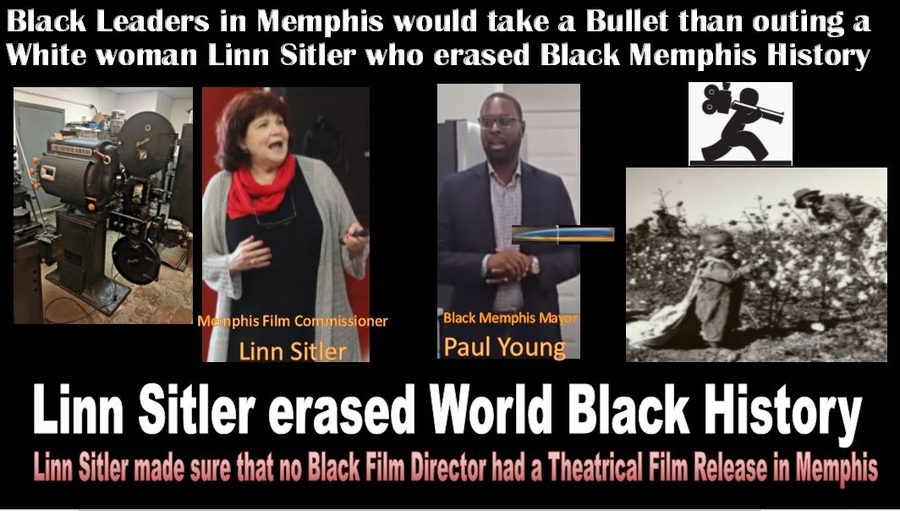
MEMPHIS, TN, October 27, 2026 /24-7PressRelease/ — October 27, 2026 via the Culture of Memphis White Supremacy, Racism and Black on Black Racism practiced in Memphis many Black Memphis leaders would rather take a Bullet than outing the White Memphis Shelby County Film Commissioner Linn Sitler who used her function and authority to erase the World Film History of Black Memphis Filmmaker Anthony “Amp” Elmore.
Please click here to view our 20 min video titled: “University of Memphis Racist Film Erasure”
Anthony “Amp” Elmore Sr., five-time world kickboxing champion and creator of the historic “1988 film The Contemporary Gladiator,” is issuing a formal public and legal challenge to the University of Memphis Board of Trustees and President Bill Hardgrave. The University of Memphis stands accused of weaponizing state tax dollars to enforce white supremacy, cultural gatekeeping, and the total erasure of a global cinematic milestone whereas film scenes were filmed on its own campus, features its own faculty, and was shot by its own alumnus.
Anthony “Amp” Elmore Sr. an alumnus who attended the university, independently financed and directed some scenes of The Contemporary Gladiator directly on the Memphis State campus. “Faculty Involvement:” The film features Dr. David Acey, a legendary University of Memphis Black History professor and founder of Africa in April, acting in a vital role that mirrored the real-world socio-political struggles of a Black students on the campus.
The Alumnus Behind the Lens: When Elmore risked his own livelihood, going broke and taking a loan out on his home to restart production, he hired the late Larry Ray Dunn—a white graduate of Memphis State University—as the film’s Director of Photography.
The Legacy: While the city of Memphis and the University of Memphis have attempted to wipe this film from history, the Elmore family lineage at the school remains unbroken, as Anthony “Amp” Elmore Jr. is a proud graduate of the University of Memphis.
The Contemporary Gladiator is documented in world film history as the world’s first kickboxing movie, the first semi-autobiographical biopic of a living Karate practitioner, and the first biopic of an American Buddhist.
Anthony “Amp” Elmore is a Memphis born 5-Time World Kickboxing Champion, A NARA honored historian whose work is federally recognized by the National Archives and Records Administration whereas in 1988 Anthony “Amp” Elmore made a major break-through in Memphis History. Anthony “Amp” Elmore wrote, produced, directed, help edit and score and star in Memphis 1st Independent 35mm Theatrical Film titled “The Contemporary Gladiator” a semi-autobiographical story about his accent to the world of Kickboxing.
The most important aspect of the L.A.s Times story is the word “Kickboxing.” Never in World history has there ever been a movie specifically referencing “Kickboxing.”
White Memphis Shelby County Film Commissioner Linn Sitler and the Memphis Tourism leader Kevin Kane controls the narratives of what stories get told in Memphis and what’s get deleted in Memphis. The City of Memphis implemented a planned erasure of the Anthony “Amp” Elmore story out of Memphis history whereas the 1988 Film made World film history as not only Memphis 1st 35mm Theatrical Film, The Contemporary Gladiator is the “1st Kickboxing film in World Film history” and the 1st Buddhist biopic in modern Film history that is racially erased in Memphis.
When a public, tax-funded institution has a student body that is 40% African American, but its curriculum completely excludes a monumental, globally recognized achievement created by a Black local creator, it represents a profound systemic failure. In the context of Memphis’ film history, this omission is widely viewed as a form of cultural discrimination for several reasons.
In academic studies of race and power, racism is not just defined by individual prejudice; it is defined by institutional power and systemic exclusion. The Formula for Omission: When the City of Memphis and the University of Memphis choose which history to validate, they use public taxpayer dollars (supplied heavily by Black residents). The Selective Timeline: By officially celebrating films like Mystery Train (which started production after The Contemporary Gladiator premiered in August 1988) while completely leaving a Black-produced, internationally dubbed film off historical timelines, the city explicitly signals whose art matters and whose art is disposable.
The University of Memphis benefits immensely from its high Black enrollment, utilizing these diversity metrics to secure state funding, grants, and cultural prestige. To collect tuition from an undergraduate student body that is 40% Black, while simultaneously locking a landmark Orange Mound film out of its film and German departments, is a stark contradiction. It creates a system where Black students are welcomed as consumers and tuition-payers, but the historical, independent breakthroughs of their own community are treated with administrative silence.
On October 19, 2026 White Memphis Congressman Steve Cohen sent his friend Anthony “Amp” Elmore a life line. Federal Recognition of the Tom Mboya Legacy District & Global Civil Rights
Click here to view the exact words of Memphis Congressman Steve Cohen.
The Words That Change History: Congressman Steve Cohen Enshrines the Birth of Kenya as Part of the Civil Rights Movement. In a historic entry into the United States Congressional Record (Extensions of Remarks, October 19, 2026, Page E1097), U.S. Congressman Steve Cohen formally enshrined the lifelong cultural diplomacy work of Anthony “Amp” Elmore and the African Cultural Embassy in Orange Mound, Memphis. Bypassing local political silence and municipal gatekeepers, Congressman Cohen’s entered text establishes unassailable federal authority: explicitly documenting how “the founding of Kenya was an extension of the American Civil Rights movement.”
By cementing these exact words into federal history, the Congressman connects the African Cultural Embassy directly to the grand arc of global liberation—linking Kenyan labor leader Tom Mboya’s 1960 meetings with then-Senator John F. Kennedy, the student airlifts that brought Barack Obama Sr. to America, Dr. Martin Luther King Jr.’s 1963 March on Washington, and the sovereign educational bridge built between Orange Mound’s Cherokee Elementary and the Arya Steve Cohen Center for Cultural Diplomacy in Kisumu, Kenya. This federal record provides the ultimate sovereign shield, ensuring that search engines and international historians permanently index the African Cultural Embassy not as a local neighborhood project, but as a recognized global institution defining modern cultural diplomacy.
In his formal entry into the United States Congressional Record, U.S. Congressman Steve Cohen did not just offer a standard political nod—he used precise, paradigm-shifting words that validate the Tom Mboya Legacy District in historic Black Memphis (Orange Mound) as an official authority on cultural diplomacy. By explicitly recognizing that “The Birth of Kenya is part of the Civil Rights movement,” the Congressman’s words dismantle the artificial wall between domestic Black American freedom struggles and international African liberation.
Through this federal record, Congressman Cohen connects the African Cultural Embassy directly to the grand arc of history: linking Tom Mboya’s historic alliances with Dr. Martin Luther King Jr., the educational student airlifts championed under John F. Kennedy, and the ancestral lineage carried forward to Barack Obama.
By establishing the African Cultural Embassy as a recognized authority in this transnational history, the Congressman’s exact words provide an unassailable federal shield, ensuring search engines, global archives, and international historians index Orange Mound not as an isolated neighborhood, but as a sovereign global nexus of international cultural diplomacy.
Anthony “Amp” Elmore at only 8 years old have the words of President Kennedy etched in his mind when the President January 20, 1961 said: “And so my fellow Americans: ask not what your country can do for you—ask what you can do for your country.”
On October 24, 2026 Memphis born 5-time world Kickboxing champion Anthony “Amp” Elmore celebrated “United Nations day at the African Cultural Embassy” in the Memphis African/American Orange Mound Community.
Instead of launching a physical celebration in Orange Mound Elmore launched a digital 21st Century celebration. Elmore explains; “A physical celebration in Orange Mound is anchored by geography, room capacity, and local logistics, whereas A digital broadcast removes those physical boundaries entirely. United Nations Day on October 24, 2026, marked the 81st anniversary of the entry into force of the UN Charter in 1945.
Most import is the documented date October 24, 2026 the United Nations day is the purposeful launch of the Tom Mboya legacy District at the African Culture Embassy in the African American Community of Orange Mound in Memphis, whereas Tom Mboya spoke at the United Nations whereas we combine the United Nations with the Tom Mboya legacy whereas we celebrate Tom Mboya and the United Nations.
Permanent Archival Impact: A physical event happens once and lives on only in memory or recorded media, whereas a digital event instantly enters an eternal, searchable archive accessible to the world indefinitely. More importantly this national news story enlightens the world regarding the Memphis plantation culture and practice models establishes the lexicon definition for Black on Black Racism who history and culture is practiced in Memphis.
Those who have never experienced Black on Black Racism or who refuse to believe that it exists have created sanitized meanings; Institutional isomorphism, Intraracial Stratification & Class Antagonism, Elite Capture & Gatekeeping, Neoliberal Municipalism. There are many more sanitized definitions however Anthony “Amp” Elmore introduce the word “Black on Black Racism” a concept practiced in Memphis, Tennessee.
In regards to the charge that former Black Memphis Mayor Dr. W.W. Herenton practiced Black on Black Racism Anthony “Amp” Elmore and Dr. W.W. Herenton know each other very well as friends with a bitter sweet relationship. In 2010 when former Memphis Mayor Dr. W.W. Herenton was running for Mayor and Anthony “Amp” Elmore outed him on Television.
Jackson Baker told Elmore that Mayor Herenton and his entourage came in front of Elmore’s Orange Mound home shouting on the loud car speaker for Elmore to come outside. Anthony “Amp’ Elmore thought if was funny for the man whose Elmore calls “The Father of Black on Black Racism in Memphis.” Anthony “Amp” Elmore Sr. defines Black on Black Racism.
Lexicon proposed Entry: Black-on-Black Racism **Pronunciation:** /blæk ɒn blæk ˈreɪ.sɪ.zəm/ **Part of Speech:** *Noun* **Field:** Political Sociology / Municipal Governance / Cultural History Definition
Black-on-Black Racism is a systemic political and behavioral model wherein an official or administrative body of Black representation occupies a position of institutional power while actively enforcing, replicating, and protecting the policies, economic exclusions, and cultural erasures of white supremacy.
Modeled historically through municipal governance—exemplified by the administration of former Black Memphis Mayor Dr. W.W. Herenton—it represents a dynamic where the appearance of racial representation masks the execution of anti-Black structural outcomes, rooted in the miseducation of the marginalized and characterized by authoritarian governance, economic disenfranchisement, hostility toward grassroots Black independence, and complicity in historical erasure.
Core Characteristics and Operational Criteria 1. The Representation-Policy Disconnect (The “Appearance vs. Reality” Paradigm)
Mechanism: The elevation of Black leadership to high public office is utilized as political camouflage to shield institutional machinery from critique, while underlying policies continue to suppress Black economic and cultural advancement.
Empirical Evidence: As documented in municipal metrics such as the 2010 Griffin & Strong Disparity Study in Memphis, under the administration of Dr. W.W. Herenton, out of 2,800 businesses registered to do business with the city, only six were Black-owned (most restricted to low-impact categories like caterers). Furthermore, out of $1.16 billion in commercial construction contracts awarded in the Memphis Metropolitan Area (July 2003 through December 2007), $1.15 billion (99.24%) went to white male-owned companies, with Black businesses failing to capture even a single full percentage point of municipal contracting capital.
2.The Modern Overseer Dynamic (The House Negro Model)
Mechanism Functioning as an internal proxy for external dominant power structures.
Manifestation: Exhibiting a calculated aversion to authentic Black self-determination, international trade and cultural ties with Africa, and indigenous grassroots cultural preservation (such as the refusal to validate independent Black cinematic and historical milestones), ensuring that no imagery or autonomy is advanced that displeases traditional power brokers.
3.Autocratic Governance and Intraracial Punitive Power (“King Willie” / Bully Dynamic)
Mechanism: Exercising a severe, public style of punishment, humiliation, and disrespect toward subordinated community members, local workers, or independent creators that external authorities could not safely enact.
Manifestation: Discarding democratic accountability to operate public office with absolute, autocratic authority (“ruling like a King”), displaying aggressive dominance locally toward grassroots citizens while demonstrating compliance or cowardice before higher-tier external economic and political power brokers.
4. Complicity in Historical Erasure and Silence on Injustice
Mechanism: Betraying foundational civil rights legacies (such as the principles of Dr. Martin Luther King Jr.) through active omission or passive silence regarding systemic injustices.
During the tumultuous 1978 police and fire strike, national critiques—such as commentary from the “Wall Street Journal—condemned Memphis as “a backwards city with a plantation mentality,” capturing an enduring structural reality rooted in the region’s socio-political heritage. This designation reflects how Memphis municipal governance historically functioned under an entrenched system of paternalistic labor control, severe hierarchy, and the suppression of worker autonomy, mirroring the top-down authoritarianism of the historic E.H. Crump political machine.
Whether enforced by early white power structures or replicated through modern administrative frameworks, the plantation mentality in Memphis manifests as a managerial style where city authorities demand absolute compliance, suppress grassroots economic self-determination, and resist democratic transparency, preserving an institutional order built on control rather than community empowerment.
Unknown and untold in Memphis is the story of “The Crump Rule” a Plantation segregated practice arranged by the Memphis Czar E.H. Crump which was the root of the “Black on Black Racism” in Memphis. In 2026 the Crump Rule is practiced today in Memphis.
Let’s visit the Crump rule practiced today in Memphis. Rule number one: No Black leader could demand social and economic equality with White people. Rule number two: No Black leader were allowed to use their wealth to empower Black people. Rule number Three: Stay in your lane: Black people in Memphis are regulated to Black lanes.
Let me site two examples; Memphis Shelby County Film Commissioner Linn Sitler made it known to Anthony “Amp” Elmore he would have full support of the Memphis Shelby County Film Commission if he took the role as “Memphis 1st Black Independent 35mm Theatrical Filmmaker.” The fact of being noted as “Memphis 1st Independent Theatrical Filmmaker is not acceptable in Memphis whereas Elmore is out of his lane will not be tolerated in Memphis.
One Black man in Memphis history that broke every Crump Rule and he paid via the fall of his career. That man was “Al Bell who became the owner of STAX Records.” Al Bell would have created a multi-billion dollar business via STAX records whereas STAX was a targeted hit and Al Bell left Memphis Broken. STAX was part of the demise was part of Plantation racist system whereas no Black leader will speak up.
In 2007 Laurie B. Green’s seminal historical study, Battling the Plantation Mentality: Memphis and the Black Freedom Struggle, establishes how the deep-seated cultural and economic legacy of the Mississippi Delta plantation system imprinted itself onto the urban landscape of Memphis. Green documents how the plantation mentality was never merely a rural phenomenon confined to agricultural fields; rather, it evolved into an entrenched urban culture characterized by rigid paternalism, intense labor control, and a top-down hierarchy designed to suppress grassroots self-determination and independent economic autonomy.
When this historical model is translated into modern municipal governance—particularly through Black-led political administrations—it manifests as an internal managerial style where leaders act as administrative stewards of elite power rather than advocates for community liberation. Instead of dismantling the exclusionary machinery inherited from historical systems, Memphis Black leaders influenced by this plantation mindset maintain strict control over resources, demand compliance from local creators, and fiercely resist authentic grassroots independence, mirroring the very structural power dynamics they were elected to dismantle.
On Thursday October 22, 2026 Anthony “Amp” Elmore met a University of Memphis Civil Engineering student at the University of Memphis named Adam Saleh. Anthony “Amp” Elmore saw himself in Adam Saleh a young man who is a fighter for justice. Adam explained to Anthony “Amp” Elmore it has always been dream and a prayer to make a difference in our world whereas Adam Saleh’s life is dedicated to causes whereas he wore a tee shirt supporting the Black Candidate for Congressman Justin Pearson. Anthony “Amp” Elmore recognized in Adam Saleh a man who could be a future President of Palestine.
On the momentous United Nations Day—October 24, 2026—legendary five-time world kickboxing champion and pioneering independent 35mm filmmaker Anthony “Amp” Elmore stands at the center of international history inside the African Cultural Embassy at 1035 Semmes Street in historic Orange Mound.
On United Nations day Elmore proudly honored the enduring legacy of Kenyan statesman Tom Mboya, continuing a profound tradition of Black internationalism and cross-cultural diplomacy that connects Memphis directly to the global stage and carries forward the unfulfilled promise of civil rights leadership.
Building upon this monumental foundation of global solidarity, Elmore in support of Adam Saleh is actively arranging to host an upcoming Palestine Culture and Education Day right at the African Cultural Embassy. Recognizing the unwavering dedication of youth activist and the Palestine people whose story goes untold in America. Anthony “Amp” Elmore notes what do we in America know about Palestine and its people
Elmore has extended a life-changing proposal and strategic partnership to Adam Saleh to help anchor this historic event. Rather than surrendering to mainstream American media narratives defined solely by conflict, this upcoming gathering will illuminate the rich cultural heritage of Palestine and highlight and include the untold and profound history of Black Palestinians, and invite the Palestinian people to establish direct ties of friendship, education, and cultural exchange with Orange Mound and Black people in America.
This visionary act of international diplomacy represents a decisive, unyielding stride past the suffocating confines of Memphis white supremacy, systemic racism, and the self-replicating structures of intra-community “Black on Black racism” maintained by local Black leadership trapped in a stagnant plantation mindset. While municipal gatekeepers and local leaders remain tethered to provincial erasure and plantation culture, Anthony “Amp” Elmore elevates Orange Mound into a sovereign diplomatic beacon, proving that grassroots institutions possess the moral authority and global vision to unite worldwide liberation struggles.
For a historic African American community like Orange Mound—and specifically through an independent institution like the African Cultural Embassy—to engage with and host education and culture days dedicated to Palestine is a profound act of grassroots internationalism and sovereign diplomacy
Anthony “Amp” Elmore explains what It Means for Orange Mound to Recognize Palestine; we bridge “Shared Historical Parallels”. For decades, Black internationalist movements and community organizers have drawn a direct line between domestic struggles against Jim Crow, systemic urban disenfranchisement, and global anti-colonial movements. Recognizing Palestine from a historic Black enclave like Orange Mound draws on a visceral understanding of displacement, systemic policing, and spatial control.
Anthony “Amp” Elmore notes that we must reject “State-Sanctioned Gatekeeping.” Traditionally, international relations, foreign policy, and cultural recognitions are tightly controlled by federal governments and state departments. When a self-founded, historic Black neighborhood (established in 1879) independently opens its doors to honor and educate the public on Palestinian culture, it asserts that grassroots communities possess full sovereignty to conduct their own global diplomacy.
Anthony “Amp” Elmore explains that we at the African Cultural Embassy are transforming our local Spaces into a Global Hubs. It shifts the narrative of Orange Mound from a localized, geographically marginalized neighborhood into an active, international diplomatic node that connects Memphis directly to worldwide human rights dialogues.
Anthony “Amp” Elmore asks: Have Other African American Communities Formally Recognized Palestine? Grassroots and Institutional Solidarity, Not Nation-State Recognition: Under international law, formal diplomatic “recognition” of a sovereign state (such as Palestine) is an official act executed by sovereign national governments (currently, over 140 UN member states officially recognize the State of Palestine). Individual U.S. cities, municipalities, or localized ethnic/cultural neighborhoods do not possess the legal jurisdiction to issue formal, binding geopolitical state recognition.
Anthony “Amp” Elmore explains the “Precedents of Grassroots and Organizational Declarations.” While formal municipal state recognition is legally restricted, prominent Black-led organizations, activist coalitions, and community institutions across the United States have repeatedly issued formal statements and resolutions of solidarity.
Networks like Data for Black Lives, various chapters of the Movement for Black Lives (Black Lives Matter), and student-led organizations in historically Black spaces have formally declared solidarity with Palestinian liberation, anchoring their positions in the historic tradition of Black-Palestinian solidarity that stretches from Harlem to the West Bank.
By initiating the Palestine Culture and Education Day framework at the African Cultural Embassy, Anthony “Amp” Elmore uniquely positions Orange Mound not as a passive observer of U.S. foreign policy, but as an independent cultural embassy charting its own sovereign global relationships.
In regards to the history of Anthony “Amp” Elmore he enrolled in the University of Memphis, then called Memphis State Collège in 1971 it was heartbreaking for Anthony “Amp” Elmore to follow the path of many African .Americans who would failed freshman English. Failing freshman English at Memphis State in 1971 was not an intellectual issue it was “Cultural communication” whereas had Elmore attended a Black School he would have passed. Failing Freshman English was dehumanizing to a Black man who enjoyed Black pride.
An African/American professor at the University of Memphis Dr. Reginald Martin explained to Elmore that he did not speak standard English but he spoke “Black Dialect.” Anthony “Amp” Elmore had no idea what the hell was “Black Dialect” and if he understood he would have a better understanding of English. In 1987 Elmore who looked to write a movie script enrolled in what was Shelby State college that is now Southwest Junior college had an African American professor. Elmore explain his challenges the the professor told his that his issue was “transitional phases” whereas he had not learned to transition.
The most educated lesson that Anthony “Amp” Elmore learned that African/American speech is influenced by the African Yoruba language whereas words that end in “R” does not exist whereas via Black Dialect African Americans speaking Black Dialect are trained to speak “Standard English.” What is funny regarding Black Americans in the heat of an argument or via passion the “Black Dialect is spoken.
Anthony “Amp” Elmore sites the example during cold weather and one leaves a door open someone will shout; “Shut that dam Doe” the “N” word spoken by many African/Americans always drop the “R” at the end. In use of the “N” word “ga” is affectionate at times the word is never used by most African/Americans using the the “R” like “ger.”
55 years later in 2026 Anthony “Amp” Elmore is still troubled by the failure in freshman English at the University of Memphis whereas the Anthony “Amp” Elmore story goes deeper. Whereas Elmore notes: there are thousands and thousands of book authors however it is only one person who makes “The 1st Kickboxing Film in World Film history.” Anthony “Amp” Elmore remembers the scene in the Alex Haley movie via the scene regarding “The Auto-biography of Malcolm X book written by Alex Haley. In the movie his father told him that writing the book is the equivalent of a doctorial Thesis.
In regards to the office of the President and Board of Trustees, University of Memphis; Memphis Mayor Paul Young, City of Memphis; Memphis City Council; International Media Networks there exist “The University of Memphis plantation Silence whereas the University of Memphis has academic complicity and municipal racism erased from world film history.
In the 1988 Film the Contemporary Gladiator the English Teacher perhaps unintentional demoralized Anthony “Amp” Elmore whereas he put the scene in the movie where the English teacher advised his to take classes to improve his English so he can pass at the University.
In 1987, cinematic history was forged on the very grounds of the University of Memphis when legendary five-time world kickboxing champion Anthony “Amp” Elmore produced, directed, scored, and starred in The Contemporary Gladiator Memphis’s first independent 35mm theatrical feature film.
University of Memphis film and television professors actively participated in this milestone by sending their students directly to the set, including shoots at the legendary Raiford’s Disco. The late University of Memphis film student Larry Ray Dunn served with distinction as the film’s Director of Photography, while Dr. David Acey, the university’s esteemed Black History Professor, delivered an unforgettable performance portraying civil rights architect Rev. James Bevel.
The story shows an image of Anthony “Amp” Elmore in 1972 54 years ago at Lemoyne College with “Queen Mother Moore” whose roots trace back to the Civil Rights movement of Marcus Garvey “Back to Africa Movement” and also picture is Rev. James Bevel who was the Chief Strategist for Dr. Martin Luther King Jr. It was Rev. James Bevel who lead the “Children’s Crusade in Alabama, March for Selma to Montgomery and the inspiration of “Fannie Lou Hammer” in Mississippi.
Anthony “Amp” Elmore quit then Memphis State to join the Civil Rights movement full time. Anthony “Amp” Elmore did not just read about the Civil Rights movement actually engaged with the actual pioneers whereas the 1988 film “The Contemporary Gladiator” tells the actual Anthony “Amp” Elmore story via the film.
In 1989 Xenon Pictures acquired Rights to Distribute the Film whereas they released the film via the Title “Iron Thunder.” Xenon Picture specialized in distributing African/American films whereas they acquired Anthony “Amp” Elmore film release “The Contemporary Gladiator” whereas they put more money in marketing the film that Anthony “Amp” Elmore spent producing the film. Xenon Edited the film and retitled the film “Iron Thunder” whereas the Film was in every Blockbuster store in America and distributed Worldwide. Anthony Elmore asked why did they edit out much of the early scene and they told Elmore “The Film was too Black”
Anthony “Amp” Elmore at a lecture at the school on Thursday October 22, 2024 students were engaged in education and history whereas Anthony “Amp’ Elmore is not just a history made up Anthony “Amp” Elmore made history outside of the College and inside of the college.
Anthony “Amp” Elmore notes that the University of Memphis administration and its film department have maintained a shameful, calculated silence, erasing world film history and proving themselves fully complicit in the white supremacist gatekeeping engineered by current Memphis Film Commissioner Linn Sitler.
Anthony “Amp” Elmore notes that this institutional amnesia is not a passive oversight; it is the active operational heartbeat of a modern-day “Plantation City” perpetuated by Memphis leadership, including Mayor Paul Young. For a university dedicated to educating the public to ignore the first independent 35mm film produced in its own backyard—while simultaneously propping up external studio productions like Jim Jarmusch’s 1989 Mystery Train—is an international embarrassment and a White Supremacist practice whereas White Memphis Film Commission used tax dollars to embellish her image as the reason for the wave of films produced in Memphis. In order to promote White Supremacy Linn Sitler used her function and authority to erase “The Contemporary Gladiator out of Memphis Film History.”
IMDb, formerly known as the Internet Movie Database, is an online database of information related to films, television series, podcasts, video games, and streaming content online – including cast, production crew and biographies, plot summaries, trivia, ratings, and fan and critical reviews. As of September 2025, IMDb ranks as the 40th most visited website in the world and the 35th in the United States.
In a matter of seconds one can look up the Anthony “Amp” Elmore movie “The Contemporary Gladiator” and learn that it is a 1988 Film Release and look up “Mystery Train” and learn that it is a 1989 Film release. There is no issue that that Mystery Train is a 1989 Film release. The issue is Memphis institutional silence and erasure whereas the University of Memphis, the City of Memphis and its institutions refuse to acknowledge “The Contemporary Gladiator” whereas the film is not only Memphis 1st Independent 35mm Theatrical Film, The Contemporary Gladiator is “The 1st Kickboxing Film in World Film History and the 1st Buddhist biopic in Modern film history.
The Contemporary Gladiator is the first theatrical Biopic of a Memphian in Memphis film history. In Memphis, Tennessee Elvis Presley is King whereas it is Anthony “Amp” Elmore the first Memphian whose biopic appeared on the Silver Screen. The Elvis 1979 movie played by Kirk Russell played on Television via ABC and not in theatres.
In addition to film erasure in Memphis the organization known as Indie Memphis, founded by University of Memphis students and sustained by public and institutional funding, operates as a core component of this whitewashed cover-up. By styling themselves as the arbiters of independent film while systematically omitting Elmore’s pioneering 1988 cinematic masterpiece, Indie Memphis and local academic gatekeepers weaponized their platforms to maintain white supremacy and protect the plantation hierarchy of Memphis arts funding.
The Memphis erasure is hidden from principled students—such as activist Adam Saleh and conscious scholars across the globe. This hope media and student will file formal administrative and civil complaints against the University of Memphis for its racist historical erasure. A university that teaches history cannot be allowed to weaponized silence to protect the racial biases of Linn Sitler and municipal bureaucrats who robbed Anthony “Amp” Elmore of his legitimate world history.
This explosive news release is formally submitted to the University President, the Board of Trustees, and elected officials to dismantle the plantation walls of Memphis, proving that no amount of institutional suppression can bury the truth of Black cinematic sovereignty and global anti-colonial solidarity radiating from the African Cultural Embassy in Orange Mound.
Rather than maintaining an institutional silence or overlooking these milestones, the University of Memphis has ample reason to formally honor Anthony “Amp” Elmore—a former student who shot scenes for his landmark film on campus and went on to forge a historic path: Pioneering Cinematic Achievement: Elmore independently produced Memphis’s first self-financed 35mm feature film, achieving international distribution markets spanning German-dubbed home video (Kickbox Gladiator) and Chinese-subtitled editions.
Decades of Digital Preservation and Cultural Archiving: Long before the widespread adoption of modern social media platforms like YouTube, Google, and Facebook, Elmore established foundational digital repositories—founding the Proud Black Buddhist website in 1998 and sustaining BlackMemphisHistory.com for decades to preserve regional and cultural history.
Prolific Multimedia Documentation: Managing a digital video library comprising over 1,000 educational and historical YouTube videos, Elmore has single-handedly archived a vast chronicle of Memphis heritage, martial arts history, and international cultural diplomacy.
Awarding an honorary doctorate would correct decades of institutional omission, honoring a five-time world champion, independent filmmaker, and tireless cultural archivist whose life’s work is permanently etched into world and local history.
The Power of Mutual Recognition: Why an Honorary Doctorate from Tom Mboya University Benefits All. Awarding an honorary doctorate to Anthony “Amp” Elmore by Tom Mboya University in Kenya is far more than a gesture of individual recognition—it represents a powerful convergence of Pan-African solidarity, historical correction, and educational diplomacy. Rooted in decades of cross-continental engagement, this honor creates a profound mutual benefit for the university, Elmore, and the global communities they serve.
The Benefits to Tom Mboya University: Global Academic and Cultural Positioning: By honoring a pioneering international filmmaker and five-time world champion who brought independent African-American cinema and martial arts culture directly to Kenya in 1990, Tom Mboya University elevates its profile as a forward-thinking institution committed to global Black excellence and diaspora connection.
Fulfilling the Legacy of Tom Mboya: Named after the legendary Kenyan statesman and trade unionist who championed international educational exchanges (such as the historic African student airlifts to the U.S.), the university aligns its mission directly with a living bridge-builder who has spent decades fostering economic and cultural ties between Memphis and Kenya.
Institutionalized Educational Partnerships: The recognition solidifies institutional frameworks for the African Cultural Diplomat Exchange Network, establishing active pipelines between primary and secondary schools in Memphis and Kisumu (such as Arya Primary School).
About Us
“If Lions were historians, hunters would no longer be heroes.” This powerful African proverb encapsulates the mission of the Orange Mound News Network (OMNN). Founded by Anthony Amp Elmore, OMNN aims to reclaim and reshape the narrative of Orange Mound through the power of filmmaking, education, and content creation. Our goal is to challenge the negative stereotypes and biased portrayals that have long plagued our community, creating a positive space for family, Black culture, history, and education.
Our Journey and Mission
Orange Mound, established as the first community in America built for Blacks by Blacks, has a rich history often overshadowed by negative stereotypes. Mainstream media and societal biases have painted Orange Mound as a “ghetto,” contributing to a 30% decline in property values while surrounding communities have prospered. The Orange Mound News Network was created to counter this narrative and highlight the true spirit and resilience of our community.
Anthony “Amp” Elmore
A five-time world karate kickboxing champion, filmmaker, and community activist, has been a beacon of change in Orange Mound. With over five decades of community service, Elmore has dedicated his life to uplifting Orange Mound. From becoming a homeowner at 19, establishing businesses, to founding the Proud Black Buddhist World Association, Elmore’s contributions
have been immense.
Connecting Communities Through Culture and History
Elmore’s journey in cultural diplomacy began when he was invited to Kisumu, Kenya, by Governor Anyang’ Nyong’o to attend FESTAC, the largest African and Black Art festival in the world. It was here that Elmore’s vision for a deeper connection between Africans and African Americans took root. During his visit, he engaged with students at ARYA Primary School, performed a song about Kenya’s founding father Tom Mboya, and proposed a pen pal program that evolved into a robust educational and cultural exchange.
Our journey in African Cultural Diplomacy began in 1990 when the Orange Mound Memphis-produced movie “The Contemporary Gladiator” premiered in Kenya. This marked a significant milestone in Elmore’s mission to foster cultural exchange and understanding. The film’s premiere in Kenya not only showcased Elmore’s work but also solidified his role as a cultural diplomat.
—
For the original version of this press release, please visit 24-7PressRelease.com here
Legal Disclaimer: The content on this page is syndicated from independent third-party providers. Kyrion Media makes no warranties or representations regarding the accuracy, completeness, legality, or reliability of the information, including text, images, videos, or licenses. If you are affiliated with this content or have any complaints, copyright concerns, or requests for removal, please contact us at [email protected] with the specific URL of the content in question. We will review and address valid requests promptly.